
Book The Practical Next Step
Give readers a fast path to hotels, tours, transport, and travel security.
Affiliate links. We may earn a commission at no extra cost to you.
Thailand uses plug types A, B, C and O, with electricity at 220–230 V, 50 Hz. Most sockets you will meet are hybrids accepting these four types, but check the actual outlet. US plugs often fit; that does not mean a US appliance can handle the voltage.
Before packing, check three things separately: the shape of your plug, the input voltage on your device and whether it needs an earth connection. For the rest of your bag, use our Thailand packing list.
Coming from: which plugs fit in Thailand?
This table describes common Thai hybrid sockets, not a guarantee for every room. The device label takes priority over the country where you bought it.
| Coming from | Does the plug fit? | Adapter needed? | Voltage check |
|---|---|---|---|
| US / Canada | Type A's two flat pins and Type B's three pins usually fit | Usually no for fit; preserve earth on Type B | A 120 V-only device cannot go straight into 220–230 V. Check for 100–240 V input. |
| UK / Ireland | Type G's three rectangular pins do not fit | Yes; an earthed adapter if the device requires earth | An appliance rated for 220–240 V, 50 Hz matches the supply. |
| Continental Europe: Europlug | Type C's two slim round pins usually fit | Usually no | Check the label covers 220–230 V, 50 Hz. |
| Continental Europe: Schuko | Type F often fits physically, but its earth contacts do not connect | Yes, to preserve earth | Voltage may match; missing earth is a separate problem. |
| Australia / New Zealand | Type I's angled pins do not fit | Yes; preserve earth where required | An appliance rated for 220–240 V, 50 Hz matches the supply. |
| Japan | Type A's two flat pins usually fit | Usually no for fit | A 100 V-only device cannot go straight into Thai mains. Check both voltage and frequency. |
Socket types you will see
A Thai hybrid outlet combines openings for flat and round pins. Type A has two flat pins; Type B adds an earth pin. Type C, also called a Europlug, has two slim round pins and no earth. Thailand's Type O has three round pins, including an earth pin.
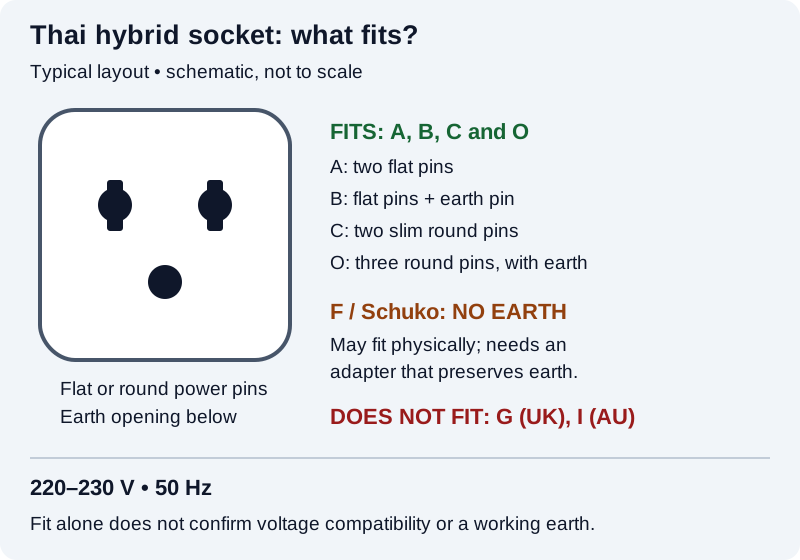
Typical hybrid socket compatibility: physical fit does not confirm voltage compatibility or a working earth.
Type O was introduced in 2006 under TIS 166-2549. The final digits use the Buddhist calendar year corresponding to 2006. The TISI standard describes household plugs and sockets; it does not itself use the letter O. That letter is the international plug-type label.
The system has been introduced gradually. Do not expect every outlet to be a dedicated Type O socket, or assume an older two-hole outlet can earth a three-pin appliance. WorldStandards identifies C and O as the official types and describes widespread hybrid sockets accepting A, B, C and O.
Some country lists also include Type F. That needs a warning: its round power pins may enter the outlet, while its side earth contacts remain disconnected. It is not equivalent to using a grounded Schuko socket at home.
Thailand voltage: read the input label first
Use 220–230 V, 50 Hz as the planning range. IEC and Power Plugs and Sockets list 220 V; WorldStandards and First Day Abroad list 230 V. These sources agree on 50 Hz. Neither figure means a Thai outlet supplies the 100–120 V expected by a single-voltage Japanese or North American appliance.
Look on the charger, power brick or appliance for a line such as:
INPUT: 100–240V ~ 50/60Hz
- INPUT describes the mains electricity the device accepts. Do not confuse it with the charger's low-voltage USB output.
- 100–240V includes Thailand's supply voltage.
- ~ means alternating current, the kind supplied by a wall socket.
- 50/60Hz means it accepts either listed mains frequency, including Thailand's 50 Hz.
A charger with that full input marking needs no voltage converter. It may still need a plug adapter. Read each label rather than assuming all phone and laptop chargers are identical.
Hair dryers, curling irons and straighteners deserve their own check. A model labelled only 120 V must not be connected directly, even if its plug slides in. If yours has a manual voltage selector, follow its instructions and set it correctly before use. If the label is missing or unclear, ask the manufacturer or leave it at home.
Plug adapter or voltage converter?
A plug adapter changes the connection shape. It does not lower Thailand's mains voltage. A voltage converter changes voltage; it must also be suitable for the appliance and its power demand.
Use this order:
- Check that the device accepts 220–230 V and 50 Hz.
- If it does, check plug fit and earth continuity. An appropriate adapter may be all you need.
- If it does not, do not plug it straight in. Check the manufacturer's requirements for a compatible converter or use an appliance designed for the local supply.
A small travel adapter is not a workaround for a single-voltage hair dryer. Do not assume a converter also changes frequency or suits every appliance. For a short trip, checking whether your accommodation provides a suitable hair dryer can be simpler than bringing conversion equipment.
Grounding and the Schuko problem
Earth, also called ground, is a protective connection. If a device requires it, the connection must continue through the plug, adapter and socket. Getting power is not proof that this protection is present.
A Type F or Schuko plug has two round power pins and earth contacts on its sides. Those pins often fit a Thai hybrid outlet, but the side contacts do not make an earth connection. WorldStandards flags this as unsafe. Use a suitable earthed adapter, such as one connecting the Schuko earth contacts to a Type O earth pin, with an appropriately grounded outlet.
Check a laptop's power brick and mains lead, not just the computer. A charger labelled 100–240 V may pass the voltage check while its three-pin mains connection still needs earth. Replacing that connection with a two-pin adapter removes the earth path.
For devices that require earth:
- Choose an adapter explicitly designed to carry the earth connection for your plug type.
- Use a suitable grounded socket; an adapter cannot add earth to an unearthed outlet.
- If you cannot confirm the connection, ask your accommodation for a suitable outlet before using it.
Two-pin Type C plugs have no earth by design. Do not treat that as permission to remove the third pin from another appliance, or force a plug into a socket that does not accept it.
What to pack and what to check on arrival
Pack around the devices you are actually taking:
- Chargers whose input labels cover Thailand's voltage and frequency.
- A plug adapter for Type G or Type I plugs, or an earthed adapter for a Schuko-equipped device.
- The correct charging cables, so you are not depending on an unfamiliar USB port.
There is no single adapter that is best for every traveller. Its input must accept your own plug, its output must suit the Thai socket, and its earth connection and electrical rating must suit the device.
Check with your accommodation if you need a particular socket or a hair dryer. USB ports and charging arrangements vary; do not plan around an assumed hotel, hostel, plane or bus charging point. At your room, check the outlet before connecting anything. If a plug sits loosely or the socket looks damaged, ask for another outlet.
For other arrival preparations, see our first-time Thailand visitor guide. Our practical information hub covers the wider trip basics.
Frequently Asked Questions
Are the electrical plugs in Thailand the same as those in the US?
US Type A and B plugs usually fit Thai hybrid sockets. The electricity is different: Thailand uses 220–230 V, 50 Hz. Check that your appliance accepts that supply. A 120 V-only device needs suitable voltage conversion, even when no plug adapter is needed.
Do I need a plug adapter for Thailand from the UK?
Yes. A UK Type G plug does not fit the common Thai hybrid outlet. Use a compatible adapter that preserves earth if your device requires it. A device rated for 220–240 V, 50 Hz does not need voltage conversion.
Can I use my hair dryer in Thailand?
Only if its input rating and instructions allow Thailand's 220–230 V, 50 Hz supply, or you have conversion equipment specifically suitable for it. Never connect a 120 V-only dryer directly. For a switchable dual-voltage model, follow the manufacturer's setting instructions.
Does Thailand use three-pin plugs?
Yes. Type B and Type O have an earth pin, and common hybrid sockets accept them alongside two-pin A and C plugs. Check the actual outlet: a two-hole socket cannot provide the earth connection a three-pin device needs.
Is Thailand 110 V or 220 V?
Plan for 220–230 V at 50 Hz, not 110 V. Sources differ between 220 V and 230 V, so check that the appliance's input range covers both. A label reading 100–240 V, 50/60 Hz covers this supply.
What is a Type O plug in Thailand?
Type O is Thailand's three-round-pin grounded plug system, introduced in 2006 under TIS 166-2549. It is being introduced gradually, while hybrid sockets accepting A, B, C and O remain common. It is different from the UK's three-pin Type G plug.
Sources & References
This article is based on editorial research and verified with the following sources:

Go2Thailand Team
Based in Thailand since 2019 | 50+ provinces visited | Updated monthly
We are a team of travel writers and Thailand residents who explore the country year-round. Our guides are based on first-hand experience, local knowledge, and verified official sources.
More about us →