
Book The Practical Next Step
Give readers a fast path to hotels, tours, transport, and travel security.
Affiliate links. We may earn a commission at no extra cost to you.
Next step
Planning your stay in Bangkok?
This article helps with the trip idea. These pages help you choose the right area in Bangkok and compare hotels before rates move.
Thailand uses one standard time for the whole country: UTC+7, often called Indochina Time (ICT). It stays on that setting all year, with no daylight saving, so Bangkok, Phuket, Chiang Mai and the islands share the same clock. The Thailand time difference from home depends on whether your home city has changed its clocks.
UTC means Coordinated Universal Time, the global time reference. The “+7” means Thailand is seven hours ahead of it. You can use Bangkok as your reference for a trip anywhere in Thailand. For wider arrival planning, see our first-time Thailand visitor guide.
What time zone is Thailand in?
Thailand is on UTC+7. According to the Thai government page on Thai Standard Time, this standard applies throughout the Kingdom. The page names the Hydrographic Department as the body that regulates Thai standard time and coordinates with the International Bureau of Weights and Measures, or BIPM.
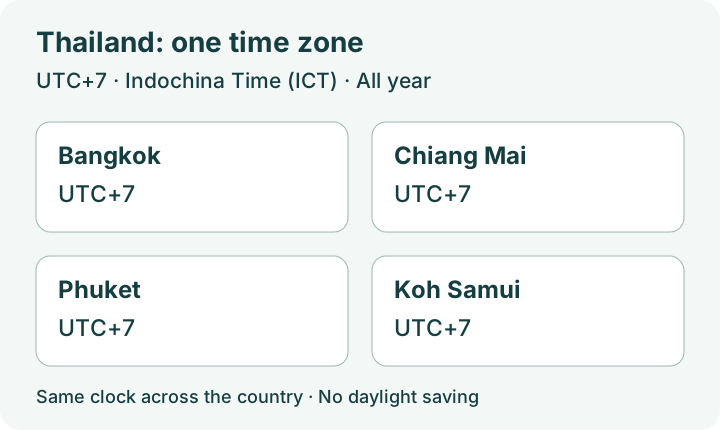 Diagram by Go2Thailand. Source: Thai government standard-time page / IANA Asia/Bangkok / offset table as cited in the text.
For a calendar or device, the useful zone name is Asia/Bangkok. This is the identifier in the IANA time zone record for Asia/Bangkok. IANA maintains a database of time zone records. Its Bangkok entry shows +7:00 from April 1920 onward.
ICT is the short name for Indochina Time, as explained in Wikipedia’s Time in Thailand article, retrieved November 8, 2026. UTC+7 describes the difference from the global reference; Asia/Bangkok identifies the zone; ICT is its common name. These labels refer to the same Thai time in this guide.
Does Thailand use daylight saving time?
No. Thailand stays on UTC+7 all year. Daylight saving time means moving the clock forward for part of the year. Thailand does not make that seasonal change.
The IANA Bangkok record has a dash in its RULES column. That means no daylight-saving rule applies to the entry. Wikipedia’s Time in Thailand article also states that Thailand has never observed daylight saving time. The Thai government page establishes standard time; the IANA record and the secondary article support the daylight-saving point.
This matters when someone at home moves their clock. Your Thai clock stays put, but the gap between you changes. Check the date of a future call rather than saving one difference for an entire trip. A meeting that suits everyone before a clock change may need a new Thai start time afterwards.
Is all of Thailand in the same time zone?
Yes. The government’s rule applies throughout the Kingdom. Phuket uses the same time as Bangkok. So do Chiang Mai and Koh Samui. There is no separate island time zone to add to your itinerary.
You do not need a new time conversion for each Thai stop. Keep the same Thai zone when moving from Bangkok to Chiang Mai, from Chiang Mai to Phuket, or between Phuket and Koh Samui. A change of destination inside Thailand does not change the UTC+7 setting.
Bangkok is simply the city used in the IANA identifier. It does not mean that the setting applies only to the capital.
Thailand time difference from the US, UK, Europe and Australia
An offset is a place’s difference from UTC. To compare with Thailand, use the other city’s offset for the date you need. The table shows both standard time and daylight time, rather than one fixed answer for each city.
| Home city | When it uses standard time | When it uses daylight time |
|---|---|---|
| London | GMT, UTC+0: Thailand is 7 hours ahead | BST, UTC+1: Thailand is 6 hours ahead |
| Amsterdam | CET, UTC+1: Thailand is 6 hours ahead | CEST, UTC+2: Thailand is 5 hours ahead |
| New York | EST, UTC-5: Thailand is 12 hours ahead | EDT, UTC-4: Thailand is 11 hours ahead |
| Los Angeles | PST, UTC-8: Thailand is 15 hours ahead | PDT, UTC-7: Thailand is 14 hours ahead |
| Sydney | AEST, UTC+10: Thailand is 3 hours behind | AEDT, UTC+11: Thailand is 4 hours behind |
These differences are calculated from Thailand’s UTC+7 and the standard/daylight offsets shown above, using the IANA civil-time comparison in our source table. “Ahead” means Thailand’s clock is later; “behind” means it is earlier.
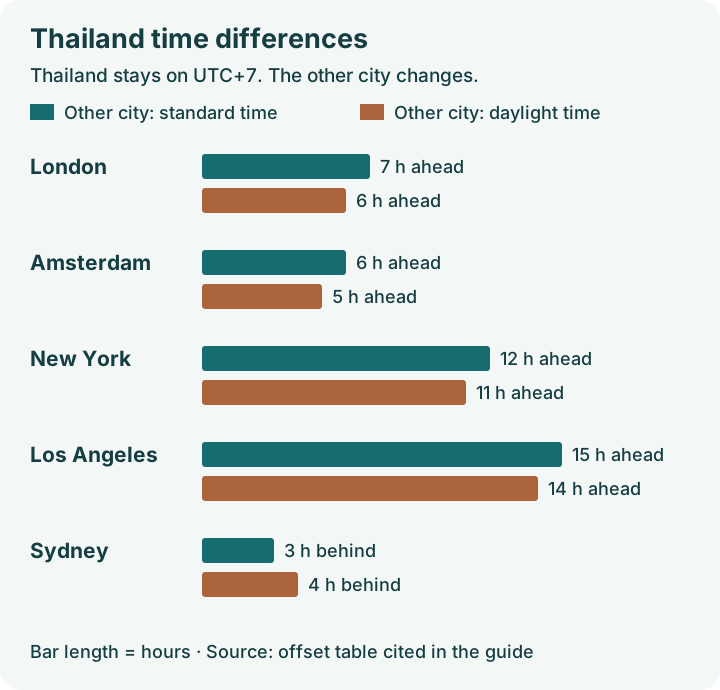 Diagram by Go2Thailand. Source: Thai government standard-time page / IANA Asia/Bangkok / offset table as cited in the text.
When New York is on EST, add 12 hours to get Thai time. When New York is on EDT, add 11 hours instead. For Los Angeles, the equivalent choices are 15 hours on PST and 14 hours on PDT. EST and PST are standard-time labels; they should not stand in for the cities’ time all year.
For the UK, use the London row: Thailand is 7 hours ahead on GMT and 6 hours ahead on British Summer Time. Amsterdam follows the CET or CEST column. Sydney needs the opposite direction: Thailand is behind Sydney, not ahead. Use the named time setting rather than a vague “summer” or “winter” label when sharing plans across countries.
What this means for calls, flights and work
For calls, write the date and zone beside the time. “Bangkok time” or “Asia/Bangkok” makes the intended setting clear. Ask the other person to confirm what their calendar shows in their own city. Include the calendar date too, since a time conversion can cross midnight.
For a recurring work call, check what should stay fixed: the Thai start time or the home team’s start time. If the home team keeps its local start time through a daylight-saving change, your Thai start time needs to move. Our digital nomad guide to Thailand covers the wider work and city choices.
For flights, read the date and time labels on the booking before converting anything. If the time basis is unclear, confirm it with the airline. Use the Thai zone for your arrival arrangements, and keep the arrival date with the pickup time. Do not use the clock difference to work out flight duration.
For family travel, keep time conversion separate from advice about settling in. Our Thailand with kids guide covers family planning. For another practical packing check, see the Thailand plug type and voltage guide.
How Thailand’s standard time was set
The Thai government page dates the national standard to a royal decree announced in Government Gazette Volume 36 on March 21, 1919, effective April 1, 1920. It describes a rule for the whole Kingdom and explains the resulting time as seven hours ahead of Greenwich, now expressed as UTC+7.
The IANA record supplies the matching technical history. Before April 1920, it lists Bangkok Mean Time at 6:42:04 ahead of UTC. It then switches to +7:00. That older value is historical; it is not an adjustment to make when planning a modern visit.
Check a time difference before you make plans
Use this short check when arranging something across time zones:
- Choose the date of the call or journey.
- Set Thailand to Asia/Bangkok, UTC+7.
- Check whether the other city is using its standard or daylight setting.
- Use the matching table column, then confirm both the time and date with the other person.
For a repeat event, check again when the other city changes its clocks. Keep the Thai zone fixed in your notes. This avoids carrying a standard-time difference into a daylight-time booking.
Frequently Asked Questions
What time zone is Thailand in?
Thailand uses UTC+7 throughout the country. It is often called Indochina Time (ICT). The IANA time zone identifier is Asia/Bangkok.
Does Thailand use daylight saving time?
No. Thailand stays on UTC+7 all year. The IANA Asia/Bangkok record has no daylight-saving rule, and Wikipedia’s Time in Thailand article says Thailand has never observed daylight saving time.
Is Phuket in the same time zone as Bangkok?
Yes. Phuket and Bangkok both use UTC+7 all year. Chiang Mai and Koh Samui use that same time too, so you do not change your clock when travelling between them.
How many hours ahead of New York is Thailand?
Thailand is 12 hours ahead when New York is on Eastern Standard Time (EST, UTC-5). It is 11 hours ahead when New York is on Eastern Daylight Time (EDT, UTC-4).
How many hours ahead of the UK is Thailand?
Thailand is 7 hours ahead when the UK is on Greenwich Mean Time (GMT, UTC+0). It is 6 hours ahead when the UK is on British Summer Time (BST, UTC+1).
Sources checked November 8, 2026. The source links above explain the national standard, the IANA record and the ICT name. Use the standard or daylight column for the other city when planning your trip.
Next step
Planning Bangkok?
Some links are affiliate — we earn a small commission at no extra cost to you.
Sources & References
This article is based on editorial research and verified with the following sources:

Go2Thailand Team
Based in Thailand since 2019 | 50+ provinces visited | Updated monthly
We are a team of travel writers and Thailand residents who explore the country year-round. Our guides are based on first-hand experience, local knowledge, and verified official sources.
More about us →